
AI’s Energy Appetite and What It Means for Your Business Costs: Insights from Our Commercial Energy Consultants in Texas
The relationship between technology growth and energy costs is becoming the most noticeable change in this decade. A March 2026 analysis from the U.S. Energy Information Administration (EIA) shows what we already knew: Accelerating data center power demand is pushing the U.S. grid toward a stress point that wholesale markets are already beginning to price in. Our commercial energy consultants have analyzed these findings closely and have been taking the proper measures to help business owners around Texas.
U.S. Electricity Demand Is Growing at a Rate the Grid Wasn’t Built For
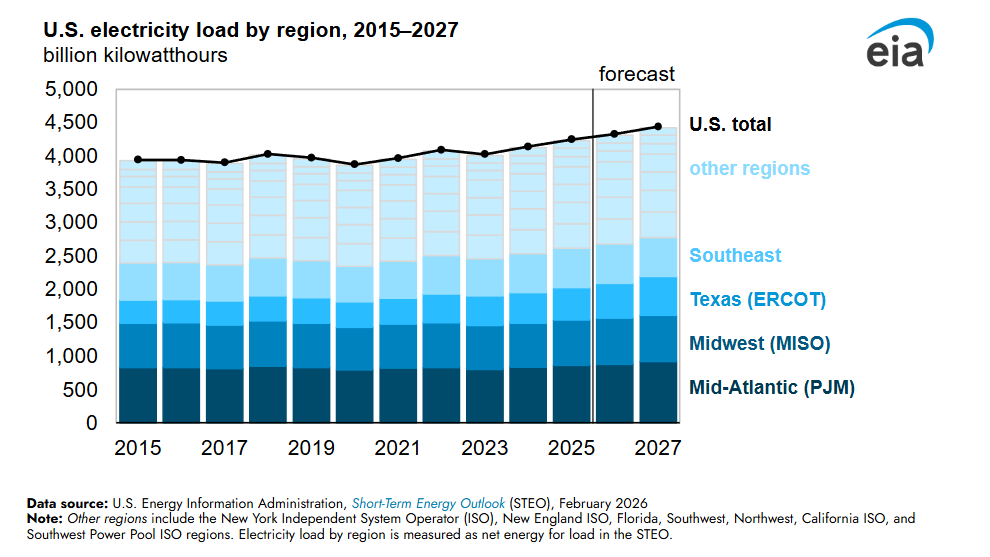
For over a decade, U.S. electricity demand barely budged—just 0.1% growth per year between 2005 and 2019. AI changed that fast. By 2025, that number had jumped to 1.7% annually, and the EIA now expects it to hit 1.9% in 2026 and 2.5% in 2027. Texas (ERCOT) and the 13-state Mid-Atlantic and Midwest grid (PJM) are absorbing most of that pressure.
Behind those numbers are data centers that never shut off. They run day and night, pulling power that the grid simply wasn’t sized for. Our commercial energy consultants aren’t seeing anything that points to a slowdown.
What Our Commercial Energy Consultants in Texas Think
Businesses across the board are getting squeezed by this. The core issue is that power supply can’t keep pace with demand—new plants take years to permit, connect, and build. So when the grid gets pushed, operators fall back on what’s already running: natural gas, and in some areas, coal.
The EIA’s high-demand scenario puts natural gas output up by 94 billion kilowatt-hours over two years. Wind and solar don’t fill that gap—they produce when conditions are right, not when the grid needs them most. Businesses in these regions are going to see the difference in their contracts, their peak-hour bills, and their demand charges.
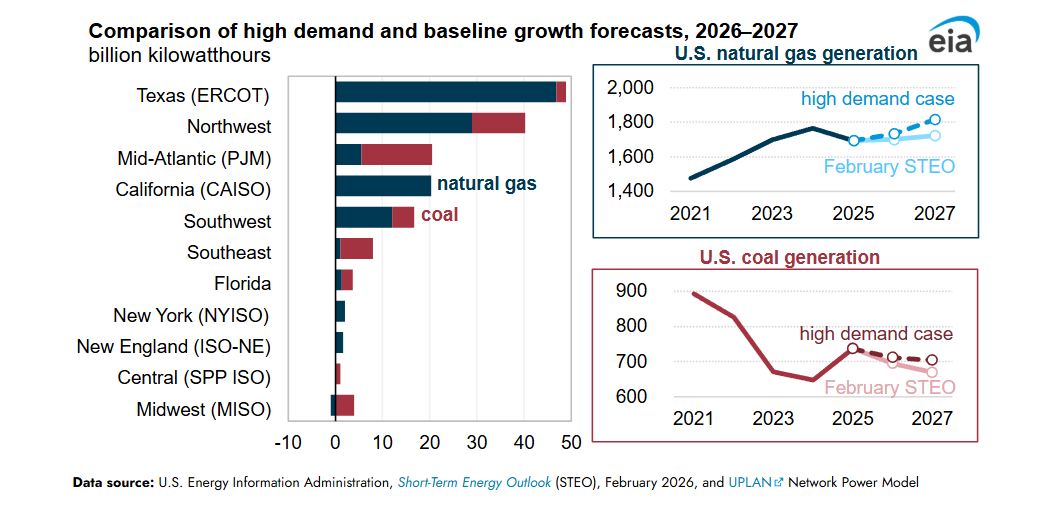
The EIA puts ERCOT at the top of the exposure list. In a high-demand scenario, Texas wholesale prices could run $37/MWh higher by 2027—that’s a 79% jump from baseline. ERCOT’s isolation makes it worse: there’s no neighboring grid to pull from when things get tight. Every late summer, demand goes up, and wind drops off—and prices follow with no ceiling in sight. Texas has been through emergency pricing events before. What’s different now is that the pressure driving this isn’t temporary. It’s baked in by years of tech infrastructure investment that’s already underway.
Cold storage, healthcare, logistics, and commercial real estate—the Texas industries we work with daily are all looking at higher bills. Without a real procurement plan in place, businesses end up absorbing higher base rates, demand charge spikes, and cost forecasts that were written for a different market. The companies that locked in agreements in 2024 or early 2025 bought themselves some breathing room. Everyone else is negotiating on worse terms now, and it’s only getting tighter heading into 2027.
⛽ Read more: Time for a Change?: Secure Your Business in Texas with Expert Energy Procurement Solutions
Are There Early Warning Signs for Commercial Buyers?
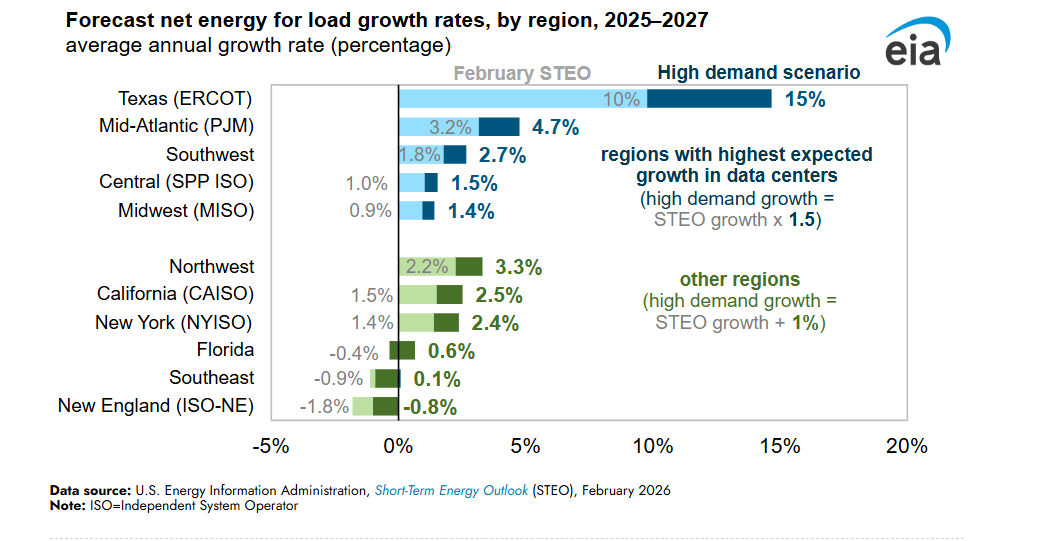
The EIA’s numbers aren’t built on speculation. Their high-demand scenario assumes 50% above-baseline growth in data-center-heavy regions—ERCOT, PJM, MISO, and the Southwest—with no changes to the current generation pipeline. That’s not a doomsday model. It’s a straight read of what’s already been announced and how long it historically takes to build new capacity. Some of the biggest tech companies have already announced plans to expand in Texas.
Waiting for your bill to spike before doing anything about it is an expensive way to learn that lesson. Energy costs get locked in through contracts, tariff structures, and infrastructure decisions that take months to unwind.
⛽ Read more: Market Intelligence
How Our Commercial Energy Consultants in Texas Use Market Data as a Strategic Signal
Our team reads EIA reports, ERCOT market updates, and regional generation data on a regular basis—not as background research, but as the foundation for how we advise clients. The U.S. energy market is repricing itself, and forward markets are already showing it.
If your contract was written in 2024, it may not hold up well against what’s coming in 2027. Businesses running operations in ERCOT or PJM without any cost exposure strategy are carrying risk they haven’t budgeted for—and it will hit the bottom line. Our commercial energy consultants work through these scenarios with clients ahead of time, putting together solutions that fit each company’s actual risk tolerance, usage patterns, and footprint.
Get the Advice of Our Commercial Energy Consultants in Texas
At Onyx Power & Gas, our commercial energy consultants know Texas energy markets from the inside. With real-time market intelligence and strategic procurement planning, we help companies convert market volatility into a competitive advantage.
Contact Onyx Power & Gas today at (877) 669-7422 for expert energy management services that help your business navigate market volatility and optimize energy costs before 2027 pressure arrives
Disclaimer:
The information provided herein in this content is for general awareness and informational purposes only and does not constitute advice. Our goal is to raise awareness and share knowledge across the energy sector. The content provided here is not intended as a sales offering. For guidance specific to your circumstances, we recommend consulting a qualified professional. You should not place undue reliance on any “forward-looking statements”, which are not a guarantee of future performance. The future results of the energy market are subject to risks and uncertainties that could cause actual results to differ materially from those expressed or implied in any forward-looking statements.
Our Partners






































Contact Onyx
Contact us today at (877) 669-7422 for proven energy management services that lower the cost of powering your home or business.
